“The doctor looked at each scar shape … and explained it clearly.”

We measure your scars,
then plan your treatment
For scars you are treating for the first time, or scars remaining after earlier treatment. Wanting to treat scars better, our doctor built the measuring device and the internal AI prediction program. RECOVER measures surface depressions and analyzes tethering patterns using internal AI predictions. The doctor palpates the scar to assess its edges and tethering, then determines treatment methods and order. At your first visit, you take home a 3D Scar Record with an explanation.Surface measurements, internal AI predictions and the clinician’s examination inform the treatment order. Take the consultation explanation home in a 3D scar record.
View appointment times →
Facial asymmetry care →
- Korean Medicine Doctor licence 24718Han Cheong Woo
- 10 years in practiceScar and skin recovery
- 10 verified visitor reviewsNaver booking and receipt verified
- Sources and review datesView sources and updates
10 YEARS · CLINICAL CONTINUITY
Ten years of clinical experience,
Ten years of clinical experience,
shown through real patient experiences
RECOVER Clinic Gangnam is the same medical institution continued from Gyurim Korean Medicine Clinic under a new name and address. Han Cheong Woo's ten years of scar and skin-recovery practice and the clinical records from before the name change remain on one institutional line.
10 yearsScar and skin-recovery practice
Same medical institutionContinuity through the name and address change
Source-linkedNaver booking and receipt-verified reviews
NAVER VERIFIED VISITS
Review three representative accounts of assessment, precision, and recommendations
All ten reviews are visit-verified through Naver booking or receipt records, and six were left by returning patients. One each was selected for scar assessment, procedure precision, and pressure-free consultation.
“I could feel how meticulous and precise the doctor was with each part of the procedure.”
“There was no pressure toward an expensive package or unnecessary procedure, which made me feel at ease.”
Reviews describe individual experiences, and outcomes vary. All 10 reviews and their sources are on the patient reviews page.
If you have read the reviews, the next step is to read your own scar by the same standard.
When scars are separated,
what to review first becomes clearer.
When pitted scars, red marks, and pigmentation appear together, one procedure name cannot explain the plan. RECOVER organizes what to calm, what to review now, and what to review later.
RECOVER SCAR
/scar →
02
Scar type
Ice pick, rolling, and boxcar scars are read separately by type, not as one problem.
Initial consultation · Start conditions
/baseline →
03
Skin readiness
Redness, pigment, and sensitivity, along with past procedures, are checked to see whether the skin is ready to start now.
Initial consultation · Access order
/baseline →
Range and priority
Across Saesalchim, laser, and skin booster, the plan separates what to address first and what to set aside for later.
Each scar needs
a different layer, direction, and interval
Once scars are separated, the next question is where to enter. Saesalchim is not a one-depth needle - RECOVER plans which layer, direction, and interval to enter by each scar's depth, edge, tethering, response, and spacing.
Depth - target layer
Small deep pits and broad shallow depressions need different target depths.
Edge - where direction changes
Sharp-edged scars are read by the border first; deep-based scars by the lower layer.
Tethering - pull beneath the surface
Broadly tethered scars and shallow spread differ in the range of subsurface pull.
Skin response - calm first or proceed
If redness, pigment, or sensitivity remains, intensity and order are adjusted to skin response.
Interval - one step or staged
The next interval and comparison standard are set around the pace of skin recovery.
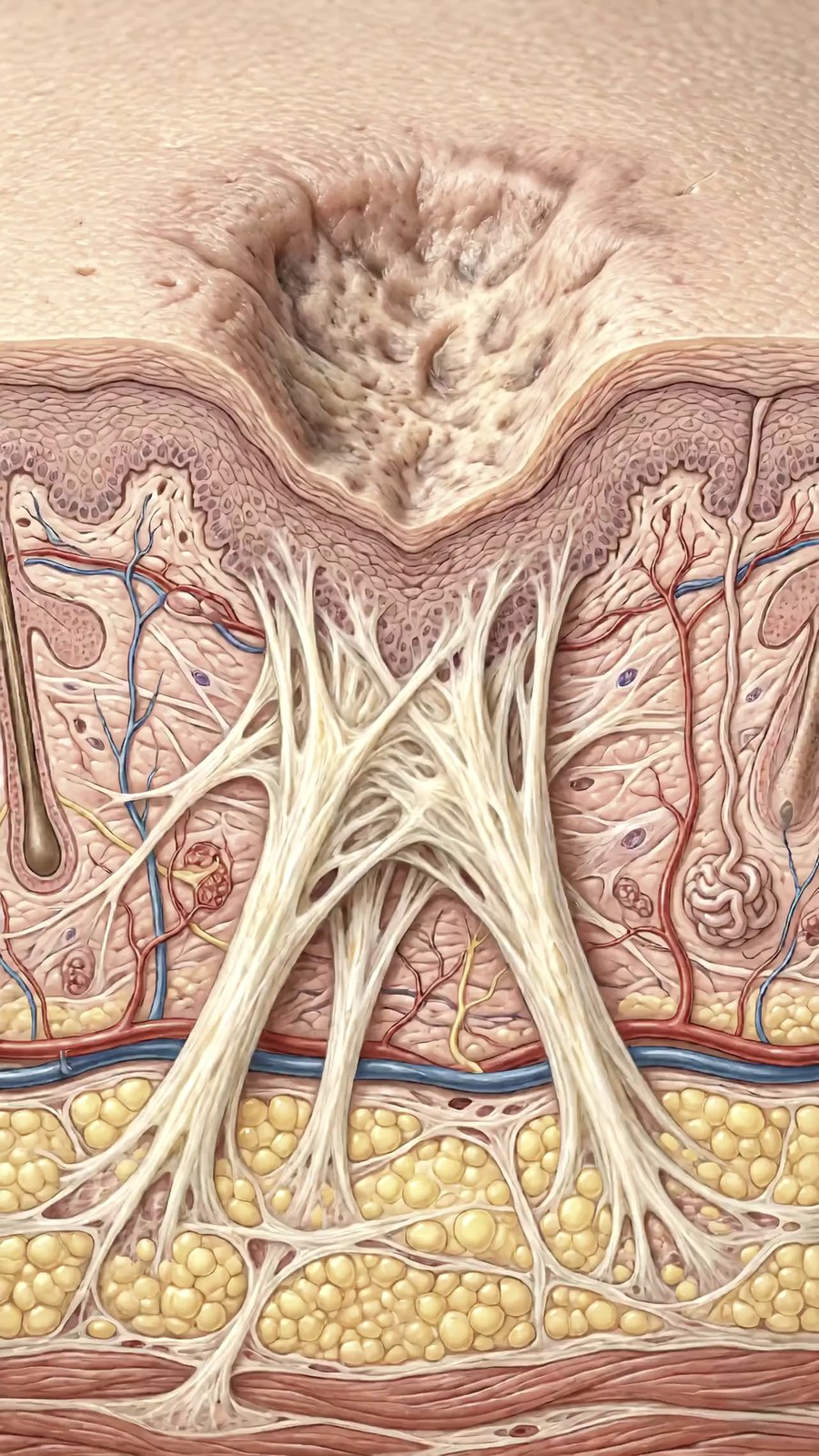
Saesalchim procedure video
We do not keep treating only the surface.
We check the tethering beneath pitted scars.
Saesalchim does not cover the scar from above; it enters from the side and releases the tethering beneath. As new tissue fills the released area, depth, direction, and interval are adjusted by scar type and skin response.
ReadCheck tethering from the side
AccessApproach only the needed layer
CompareRe-capture under the same conditions
Laser or Saesalchim?
There is something to read before the name
Two pitted scars can look alike on the surface and still be held down by different structures, and that changes the approach they need. Here is what each of the three most-compared approaches does inside the skin.
-
Filling
Filler — fills the hollow
Filler lifts the surface by filling the hollow. Some scars are joined to the tissue below by fibrous bands that hold the surface down, so before filling we first check why the scar is hollow.
-
Releasing
Saesalchim — releases the pull underneath
It enters beside the scar and cuts the fibrous tissue holding the scar down, releasing the pull.
-
Heat
Needle RF · fractional laser — prompts remodeling
A needle tip or a laser delivers fine heat to prompt collagen remodeling. It is used mainly for surface color, texture and redness.
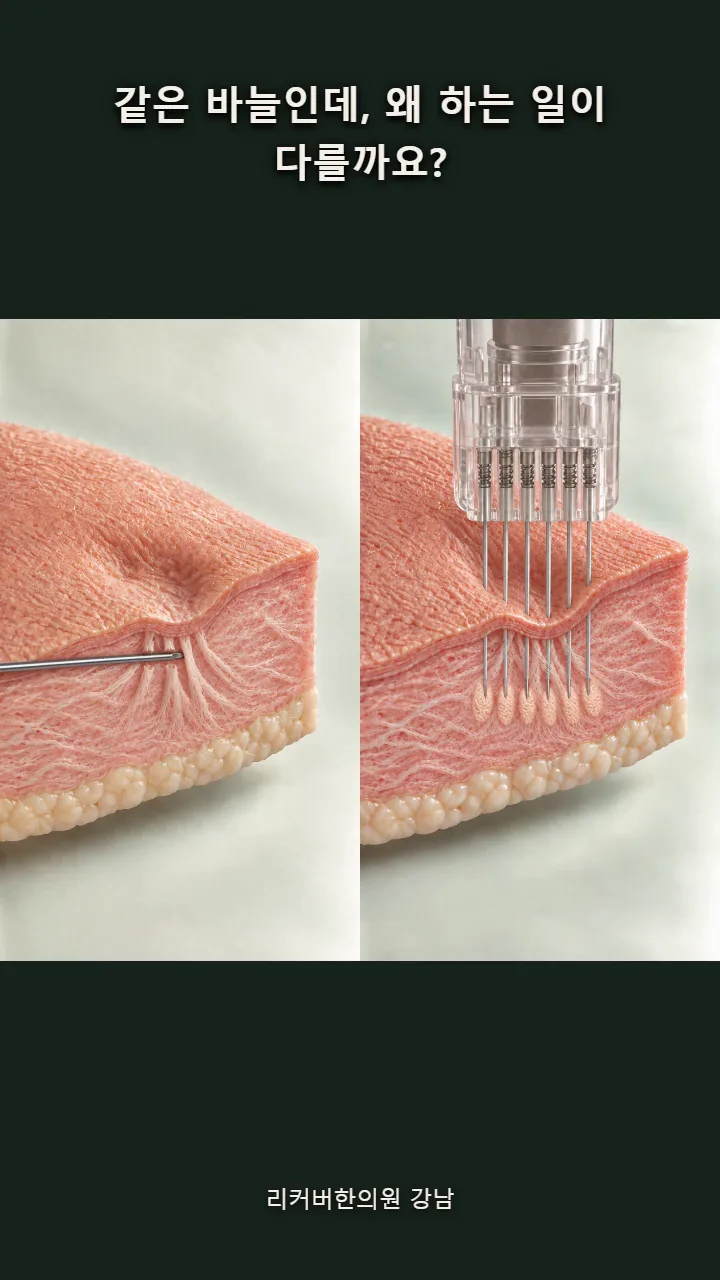
Same needle: one releases, one delivers heat
Alongside Saesalchim, RECOVER has CO2 and Nd:YAG lasers, radiofrequency and skin boosters. What comes first is decided by reading the scar's shape, depth and tethering, not by the name of a device. At your consultation, ask: “What shape is my scar, and is something pulling it down?”
The video is a conceptual explanation, not a real patient's before-and-after. Reactions and side effects after treatment differ from person to person.
Differences that surface photos miss
are reviewed on the same 3D baseline.
Clinical recording tools map scar locations and surface depressions to support clinical assessment. AI marks them; the doctor checks them directly.
The relief a single photograph misses,
raised by light from seven directions
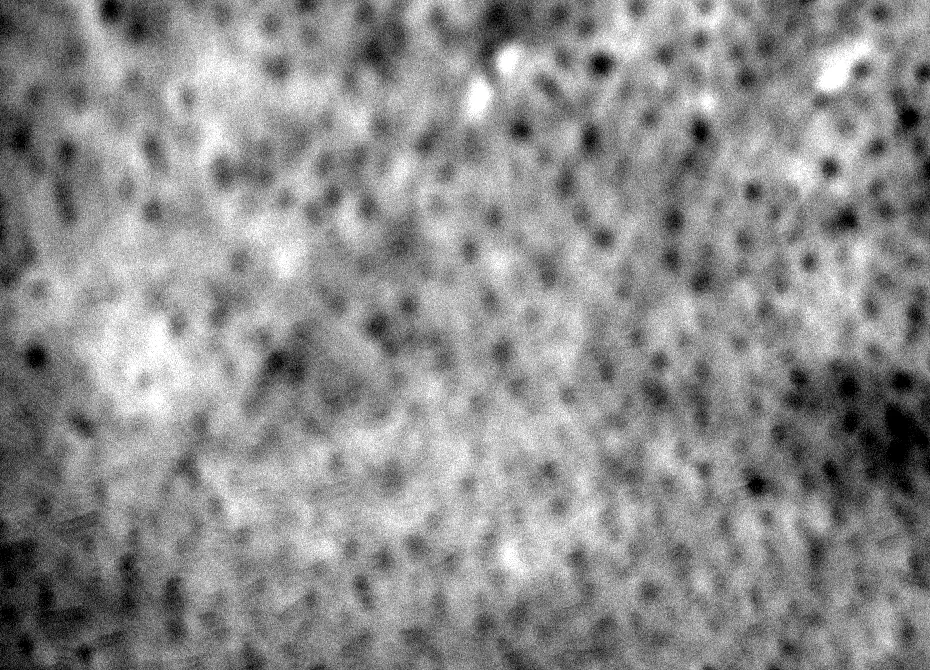
This is not a synthetic screen. It is a real record from the scar measurement device RECOVER built part by part. The skin inside a 29.4 × 21.2 mm window is lit from seven directions, and the shadows are combined to raise the surface relief in 3D. Measuring the same site again under the same conditions is the device's job; what is a scar and where to approach it is the clinician's reading.
01 / Actual captureAverage of 7 light directions
 Candidate 1
5 mm
Candidate 1
5 mm
The original frame from the camera inside the device. One pixel is 0.03 mm, so a single pore spans dozens of pixels.
02 / Surface relit from seven directions7 directions → relief
 Candidate 1
5 mm
Candidate 1
5 mm
The shadows from seven light directions are combined so that only the surface relief remains. Texture hidden under colour and redness comes through as it is.
03 / Relief raised in 3DRelative height · height ×8.5
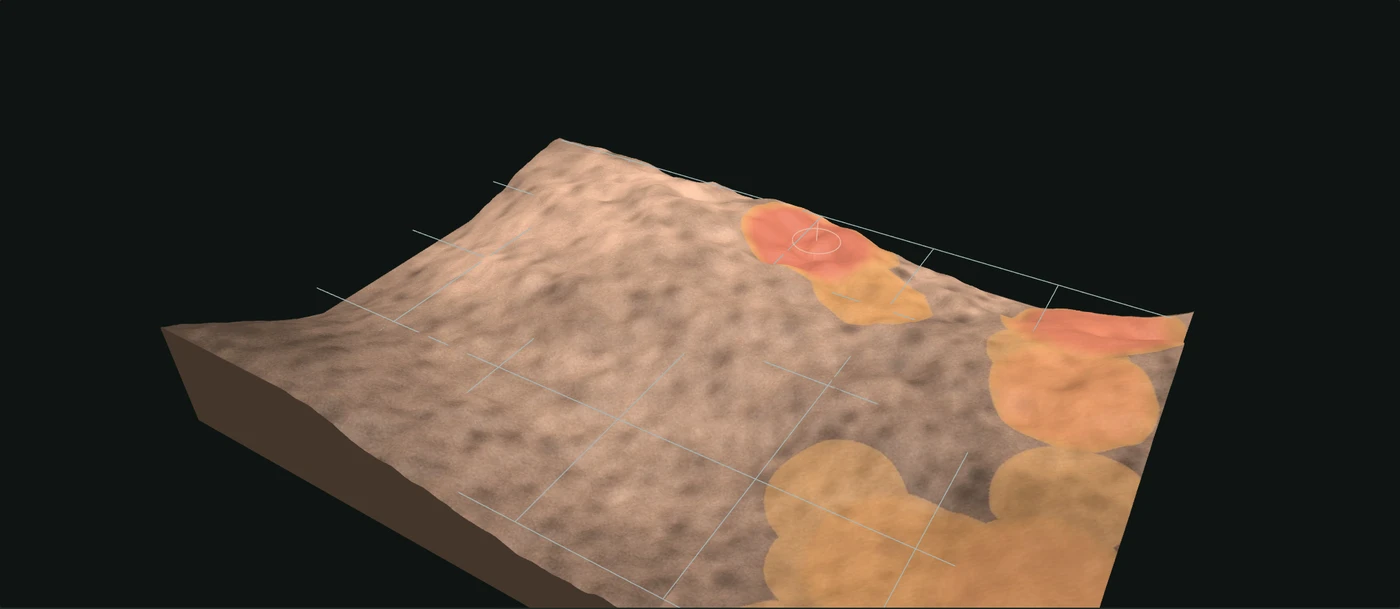
Drag to rotate · wheel to zoom
The same relief is raised as height on a grid. Where and how much the surface dips is visible at a glance, and the next visit is compared on the same grid.
The device recordsActual capture · seven-direction relief · 3D surface · candidate marks · the conditions for measuring again
The clinician readsScar type · Saesalchim approach range · required depth and direction · the next comparison items
Measured again under the same conditionsSame window · same light · same site — so a change reads as a change
We check the variation between repeated measurements
Number of times the probe was re-seated on the same site
The device sets the comparison baseline
Even lifted and re-seated,
0.05 mm or closer
Values vary when the probe is removed and placed again. In the record shown above, the comparison baseline averaged over eight placements at the same site converged within 0.05 mm. This figure describes repeated measurements in that record. The 0.01 mm figure is the recording increment for surface height. At the next visit, we compare changes using the same site and capture conditions.
One site, from the face to the cross-sectionSame scar · four scales
1 Face166.7 mm
Left cheek, where the capture window sits
2 Window29.4 mm
The window the device records in one capture
3 Scar4.0 mm
4 mm around candidate 1
4 Section0.01 mm units
The recorded height of the surface relief · deepest point
After measuring, we explain why a treatment is recommended
01 · Record the surface
We review the depressions and edges at the same scar site together on screen.
02 · The doctor examines it directly
The doctor reviews the record alongside an examination of the edges, tethering, and skin response.
03 · Explain the treatment order and its reasons
We explain what to treat first and why, and what to compare next, keeping it in your 3D Scar Record.
The diagrams below explain treatment principles. Your treatment methods and order are determined after the doctor examines your scars.
When planning treatment,
we also explain the structures beneath the skin
Depressed scars can involve both tissue loss and tethering. After examining the scar, the doctor uses 3D illustrations to explain which structures each treatment addresses.
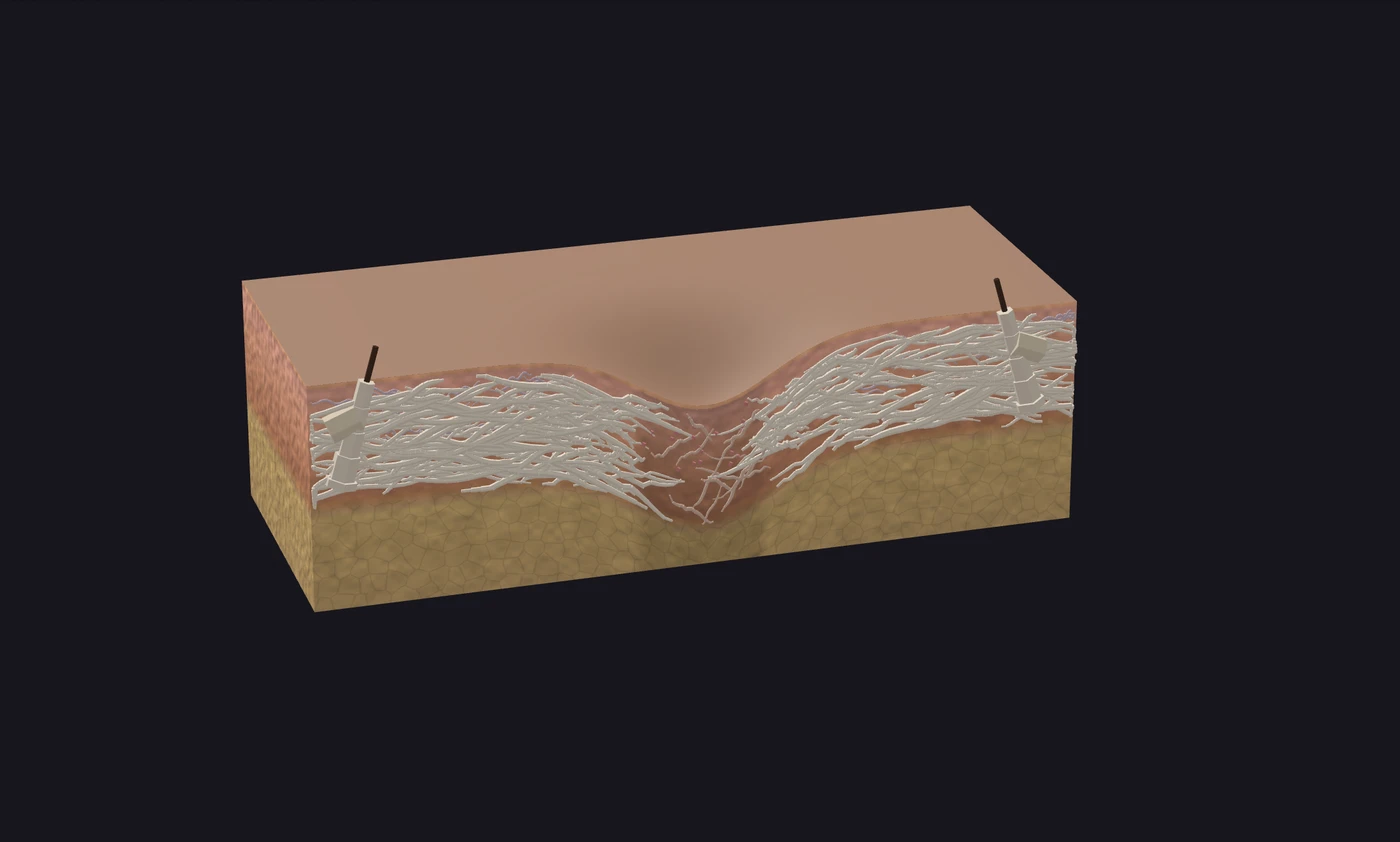
Tissue loss · loose fibres
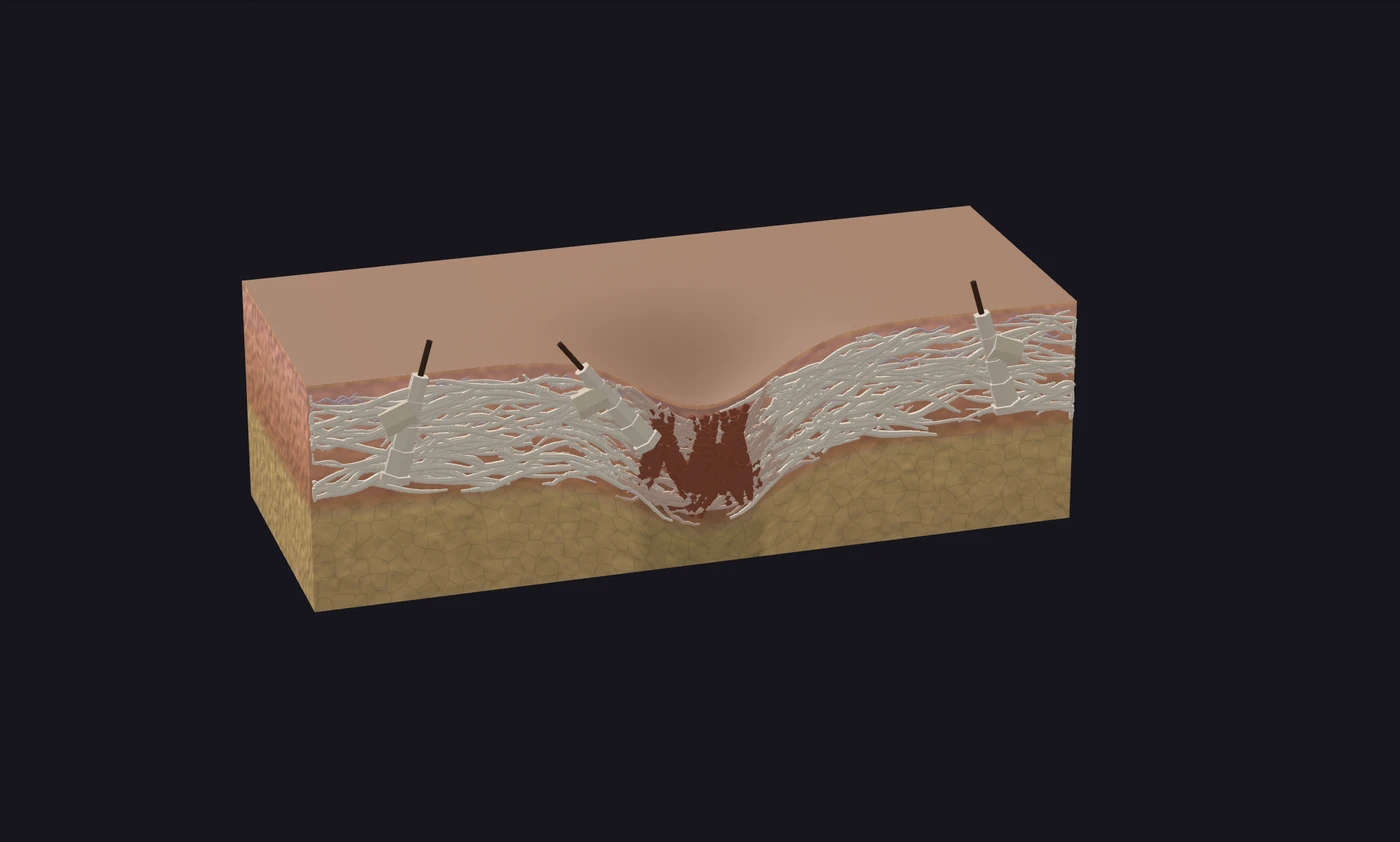
Tethering · downward pull
To provide better scar care,
we built our own measuring device
To keep one scar site under the same light and angle, we designed the lighting, controller and review screen ourselves. Surface shape is recorded in 0.01 mm units and followed with the same device, site and capture conditions. HAN PREDICT, the company that builds Clinical recording tools, was founded by Han Cheong Woo.
This is how
we review your scars together
Scar type, Saesalchim range, and left-right references are reviewed in consultation and carried into the 3D Scar Record below.
CASE 01SCAR
Depth map separating acne scars and red marks
CASE 02BASELINE
Recovery baseline separating approach range and priority
After your first consultation,
take home your 3D scar record
We measure surface depressions with our device and refer to the internal AI prediction program. The doctor palpates the scar to assess its edges and the degree, direction, and extent of tethering. We explain what to treat first and give you the details in a 3D Scar Record. At follow-up, we measure under the same conditions, explain both changed and remaining areas, and decide on the next treatment.
RECOVER · ACTUAL CONSULTATION RECORD
From capture to 3D and cross-section: an actual record
Three sites recorded for one patient on the same day. The original capture and 3D surface are reviewed together, alongside the clinician’s recorded findings.
Recorded 2026.10.24Right cheek
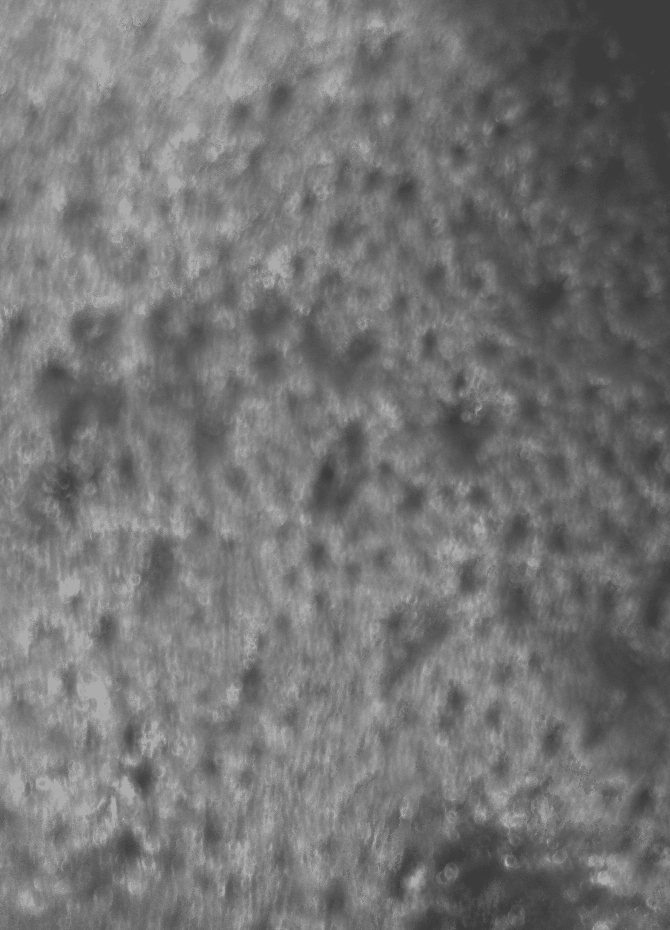
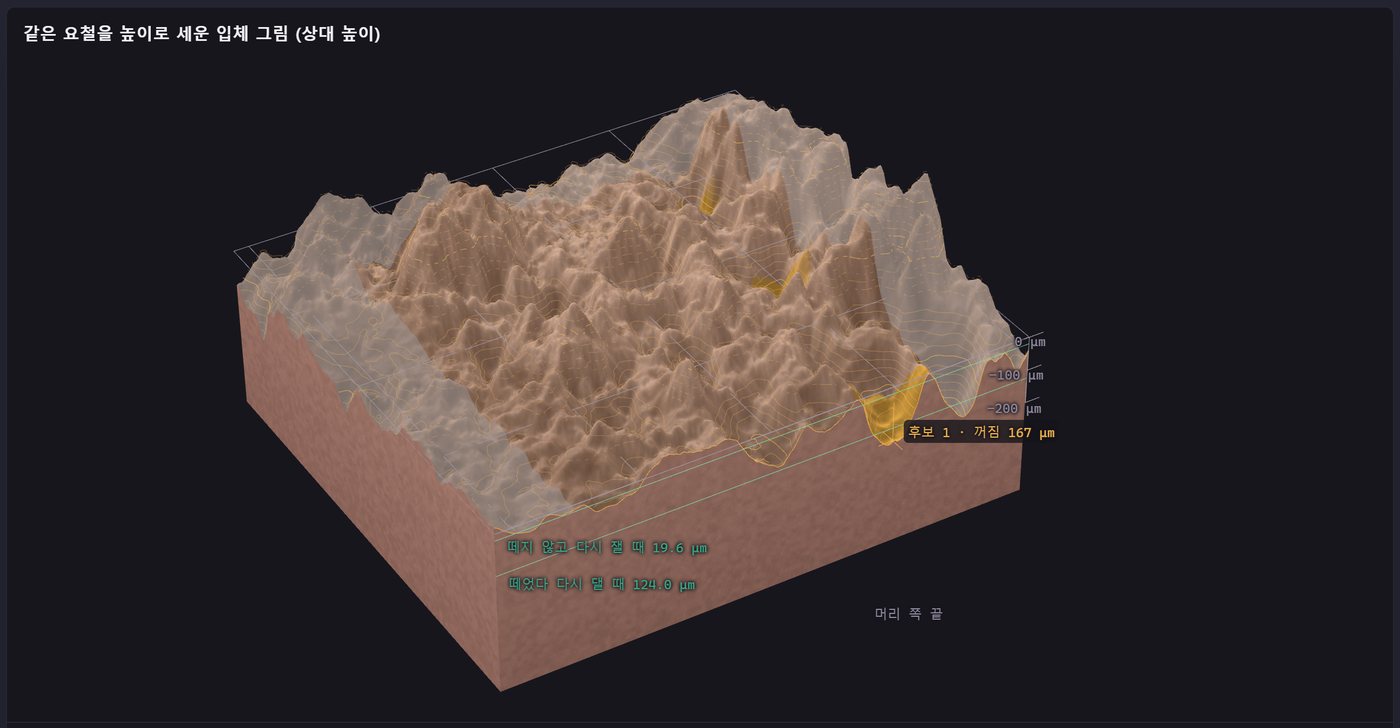
Clinician’s recorded findings Icepick, boxcar and rolling types were recorded. The approach was recorded as “address now”, with broad tethering in all directions.
Select an image to view it at its original size.
Views from one recording day, not before-and-after results. The 3D illustration exaggerates relative height; its skin tone is not the captured skin colour. Cross-section values are not directly compared between visits.
View the cross-section and other recorded sites →What the record includes
01
Where scars and marks remain
A scar map records indentation, redness, pigmentation, and texture under the same standard.
02
Scar type and depth
Your scar pattern and the layer of depression are separated by type.
03
Tethering direction and range
The note records not only surface indentation but also suspected direction and range of pull beneath it.
04
Now and later zones
Rather than reviewing everything at once, priority is staged from what matters first.
05
Redness, pigment, and sensitivity check
Recent procedure history is checked together before deciding when to start.
06
Next comparison standard
Items for the next review are set in advance under similar lighting, angle, and distance.
Before choosing a procedure name, RECOVER leaves a standard for reading your scars.
Recovery is about identifying the conditions that slowed improvement and setting a standard to compare again.

 Han Cheong Woo · Founder
Founder
Han Cheong Woo
— Founder Note
- Director
- Han Cheong Woo
- Focus
- Scars · skin recovery · facial balance
- Role
- RECOVER founder · recovery baseline design
- Research
- Kyung Hee University Graduate School · Genesis_Medicine Lab
- Tools
- Scar measuring device · 3D Scar Record · Saesalchim criteria
- Record
- Recovery progress compared by the same standard
WHY RECOVER
Han Cheong Woo treats scars and built the device he uses to measure them.
After repeated treatments, we wanted to see together what had changed and what remained. That led us to design the lighting, controller and review screen for recording the same scar under consistent conditions.
That is why the first consultation sets out, before any session count, where and how to approach the scar and what to compare against next time, in a 3D scar record.
RESEARCH LEDGER
Good recovery
Good recovery
starts with good observation.
RECOVER's research supports a more precise understanding of why scars sink, harden, and retain redness or pigmentation.
Research record →
ATMOSPHERE — 6 INTERIOR PLATES
Arrive quietly,
Arrive quietly,
capture consistently and consult calmly a space designed for that flow
The lounge, reception, consultation rooms, treatment rooms, research room and corridor at RECOVER Clinic Gangnam, in front of Seolleung Station Exit 7.
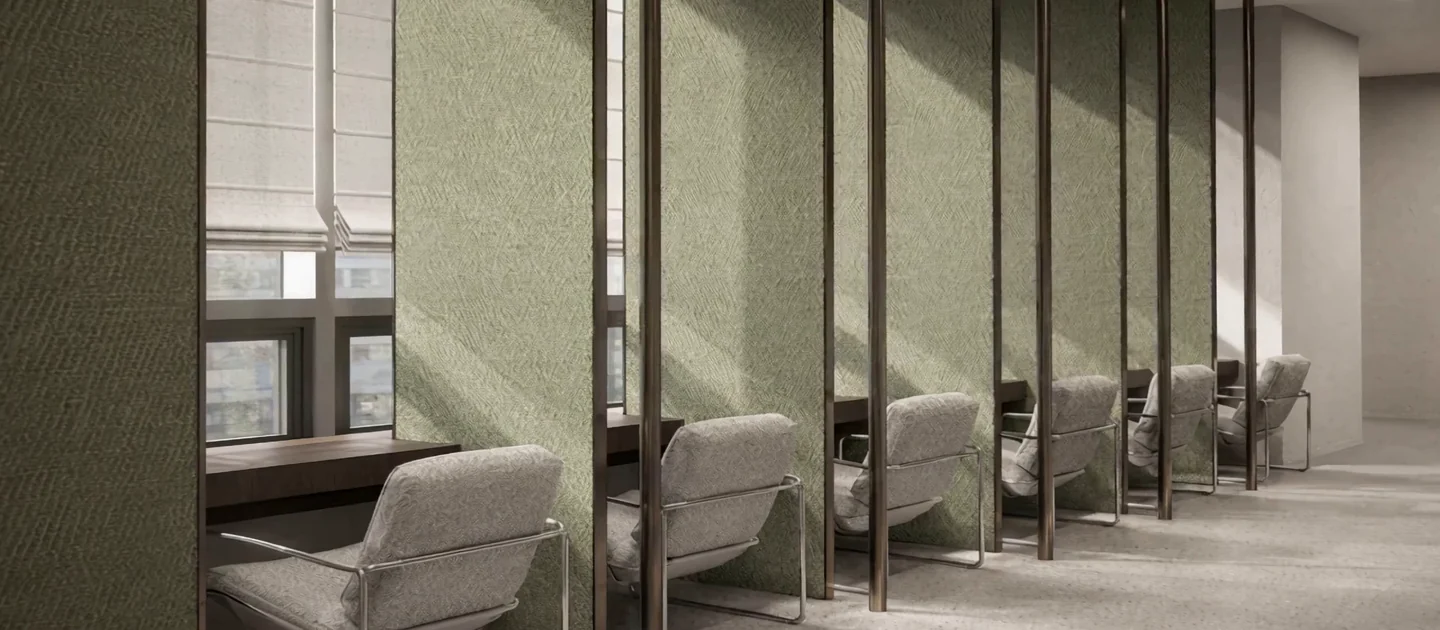 Plate 01
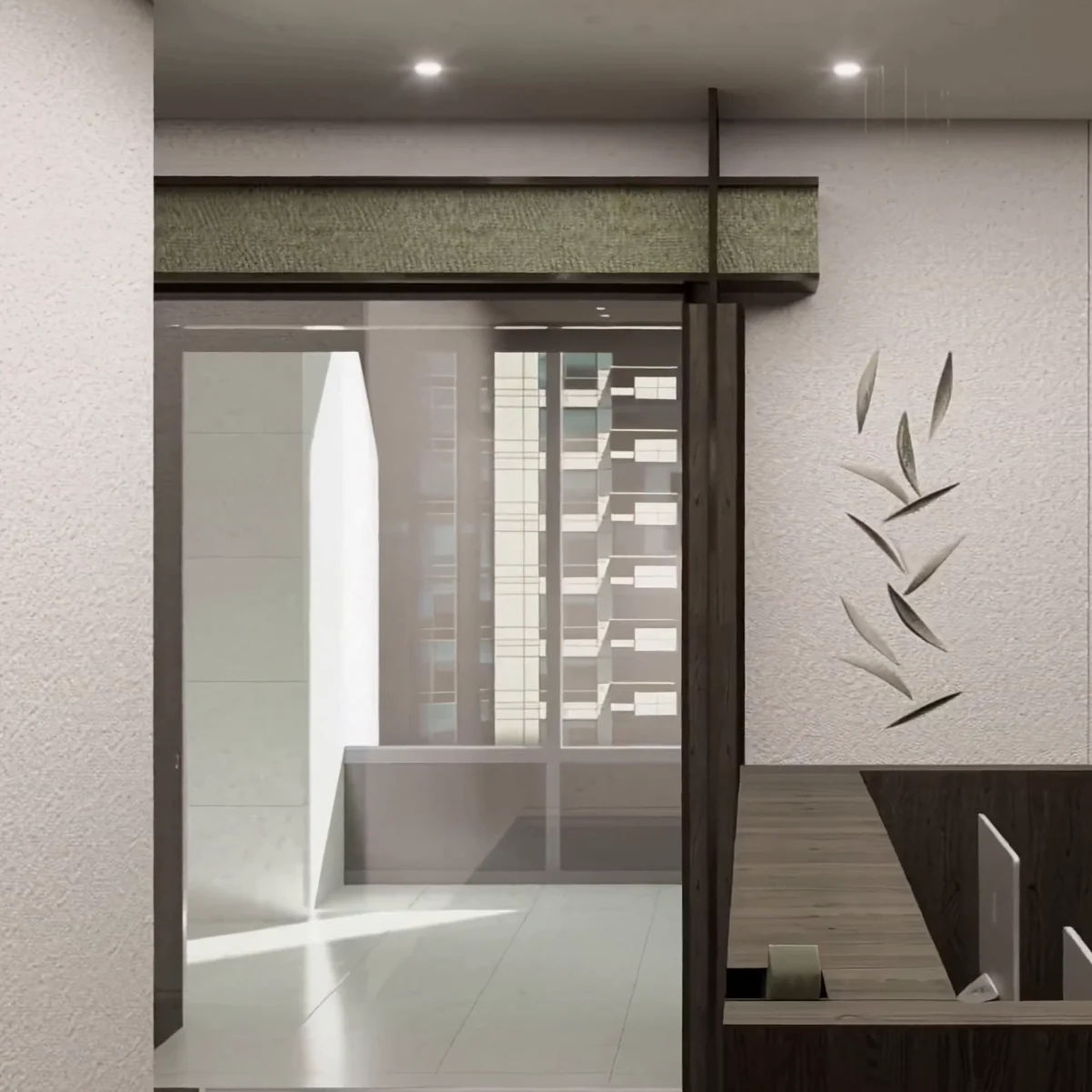 Plate 02
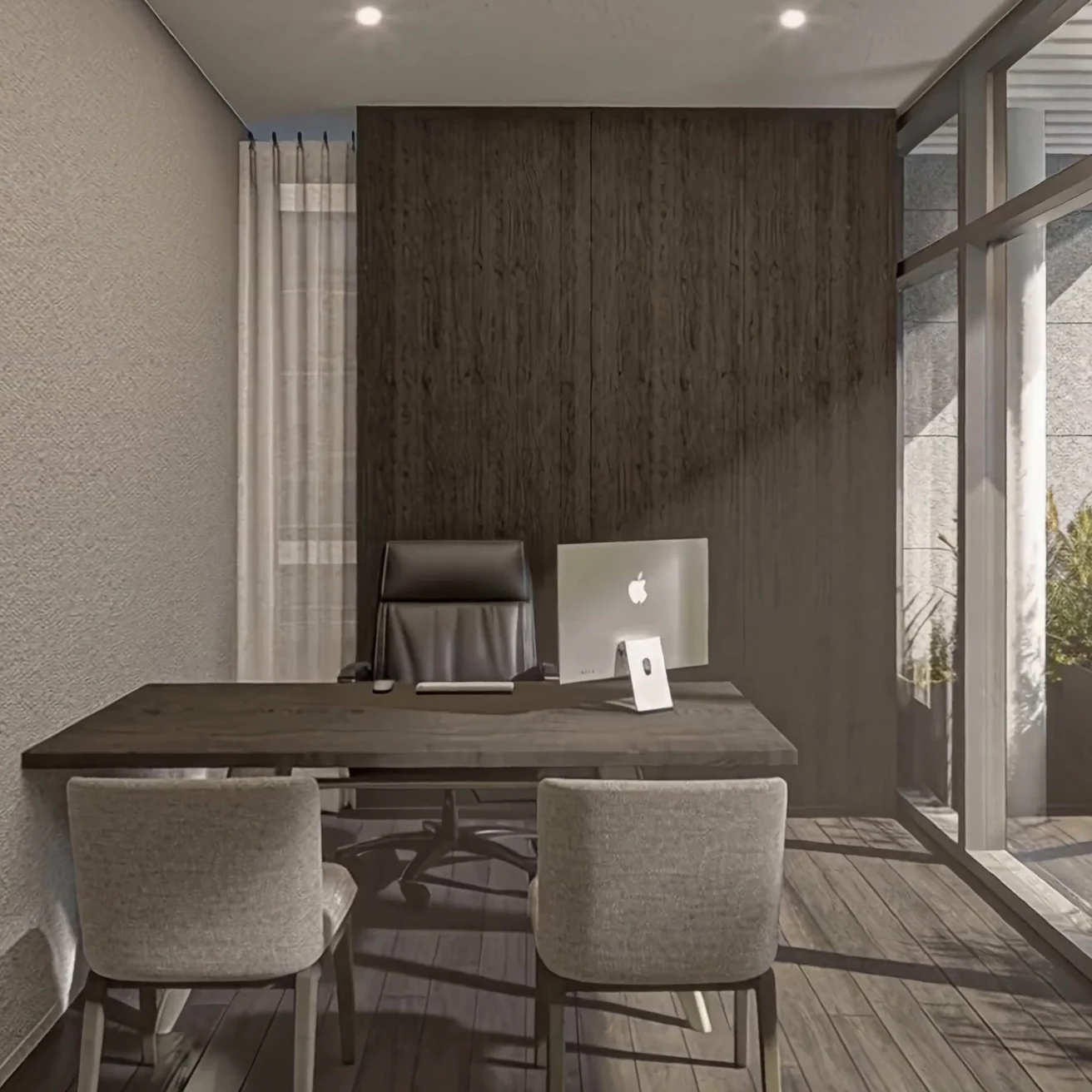 Plate 03
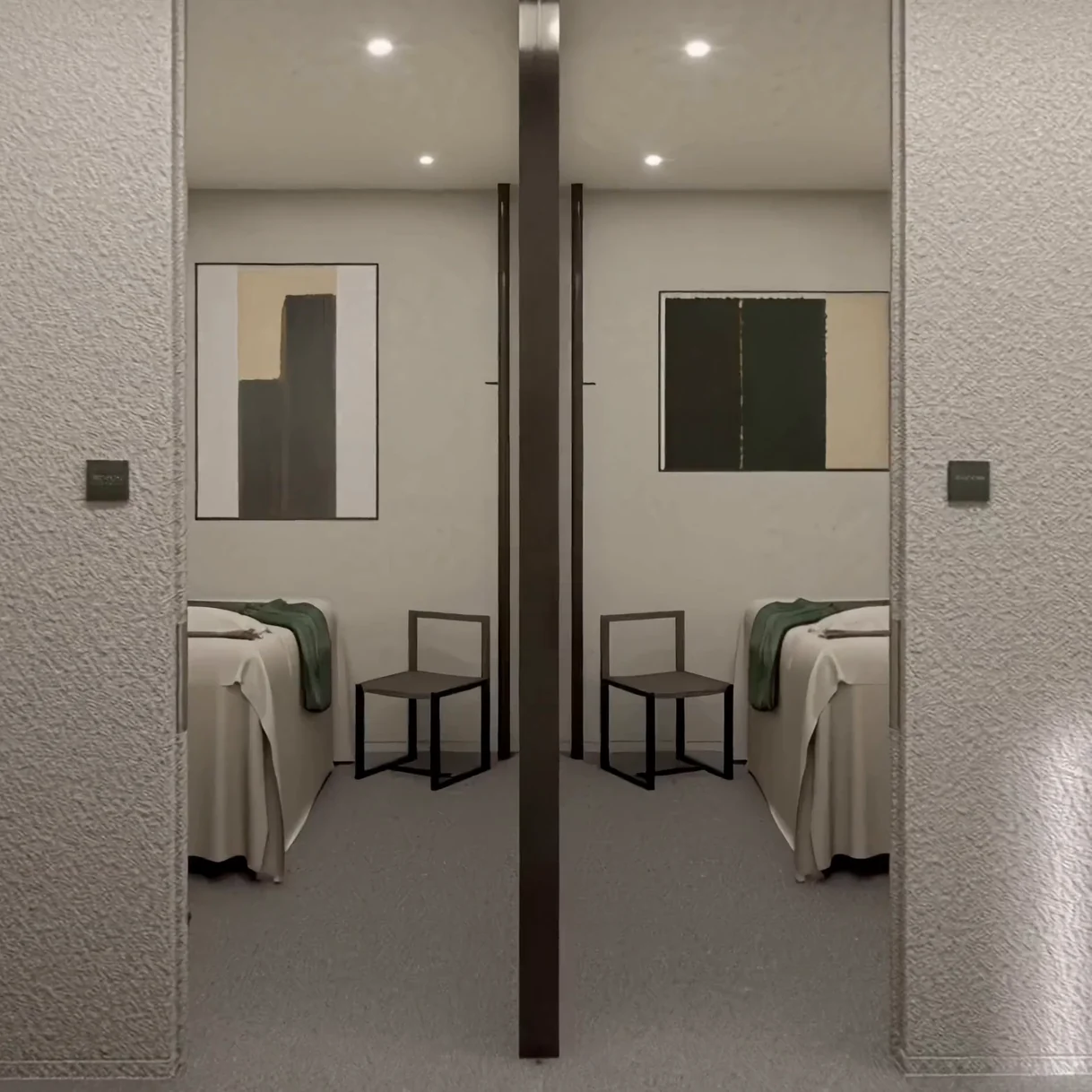 Plate 04
 Plate 05
 Plate 06
FREQUENTLY ASKED
Frequently asked questions
The consultation begins by reviewing scar location, depth, edge, tethering, redness, pigmentation, and previous treatment history. What to approach now and what to review over time are then set out in a 3D scar record for you.
What changes a scar is not the name of the clinic but the treatment that fits that scar, and the reading that chooses it. RECOVER first measures and reads the scar. Fibers tethering it from below are released with subcision and Saesalchim, surface unevenness and texture are treated with CO2 laser and needle radiofrequency, and redness and pigment with Nd:YAG laser. Subcision, fractional laser, and radiofrequency microneedling are methods with a substantial body of clinical research in atrophic acne scars, and which treatment comes in what order is decided by the physician after reading the scar structure.
Pitted scars, red marks, pigmentation, and sensitivity are reviewed by distinct criteria and in a deliberate order: what should calm first, what can be approached now, and what should be decided through follow-up.
Scars can look different depending on light, angle, and expression. RECOVER leaves a baseline from the first consultation so later skin response and next steps can be compared under similar conditions.
Yes. We review remaining indentation, redness, pigmentation, sensitivity, and texture after previous treatments. The important point is what remains in the skin now.
It depends on scar depth, width, tethering, and skin response. The first consultation sets the first approach range and a 6-12 week comparison standard, then adjusts the next step by response.
Because the process checks tethering beneath pitted scars, stimulation can be felt. RECOVER adjusts range and interval by scar depth and skin response and explains expected stimulation and recovery flow during consultation.
Redness and pigmentation follow a different standard from pitted scars. We first review skin condition and sensitivity for color changes, then assess depth and tethering for pitted scars and set the order of calming, surface care, and Saesalchim when needed.
It depends on the scar type and extent, and on which treatments are combined in what order. After the scar is read at the first consultation, we explain the treatment plan together with its cost.
RECOVER Gangnam opened on September 7, 2026. The first full consultation sets out scar type, Saesalchim range and the 6–12 week comparison baseline in a 3D scar record for you.
RECOVER offers CO2 and Nd:YAG lasers, radiofrequency, and skin boosters alongside Saesalchim. Laser and radiofrequency mainly address surface color, texture, and redness, while Saesalchim addresses the tethering and depth beneath pitted scars. What to use first is decided by reading the scar structure, not by the device, and that order and range are recorded together in the 3D Scar Record.
Both approaches consider tethering beneath pitted scars. RECOVER Saesalchim is based on side entry and detailed adjustment of depth, direction, and interval according to scar type and skin response.
Location and
first-consultation guide
RECOVER Clinic Gangnam is a Korean medicine clinic on the fifth floor of Buil Tower, in front of Seolleung Station Exit 7, that records the depth, border and tethering of acne scars under the same conditions and designs the Saesalchim treatment range. Its opening date is September 7, 2026.
— Information
- Clinic name
- Recover Korean Medicine Clinic GangnamRECOVER Clinic Gangnam · Scar Restore Design
- Address
- Yeoksam-dong, Gangnam-gu, Seoul
Buil Tower 5FIn front of Seolleung Station Exit 7 - Access
- Enter Buil Tower from the street-facing entrance in front of Seolleung Station Exit 7 and take the elevator to the 5th floor.
- Parking
- Use the mechanical parking facility behind Buil Tower. Bring your parking ticket for one hour of parking support.
- 3D scar record
- See the six items the record keepsScar location and Saesalchim approach criteria are reviewed first
- first-consultation guide
- See what the first consultation reviewsThe six items the consultation records
- Opening
- September 7, 2026
- Opening hours
- Mon, Tue, Wed, Fri 10:30-20:30 (closed 14:00-15:00) · Sat 10:00-15:00 · Closed Thu, Sun and public holidays (open on substitute holidays)
- Phone
- 02-508-1075
- Consultation channel
- Ask on the KakaoTalk channelOfficial RECOVER Clinic channel
In front of Seolleung Station Exit 7Line 2 · Suin-Bundang Line
Facial balance care,
guided by your concerns
Asymmetry is read by reference points. Points around the eyes, cheekbones, mouth, and jawline are kept in 3D and checked again by the same standard next visit.
Explore facial balance care → Explore weight management care →